
Related Downloads
Related Links
Additional
Enhanced Victim Engagement (EVE)
9. The EVE process was a pilot scheme at the time of our 2024 report and is now the national model rolled out in parallel with Summary Case Management (SCM).
10. EVE has two elements:
a telephone call from a prosecutor for all domestic abuse victims before the first case management hearing (CMH) where the accused does not plead guilty at first appearance – an EVE call
where an accused is charged with contravening section 1 of the Domestic Abuse (Scotland) Act 2018 (DASA)[8] the victim should be offered a meeting in person with a prosecutor where the case is proceeding to trial[9] – a DASA meeting
11. SCM has delivered significant measurable improvements in reducing the number of trials being fixed and the number of witnesses being cited. Three reports have been published by the Scottish Courts and Tribunals Service (SCTS) as SCM moved from a pilot in 2022 to the national model in January 2026. These reports provide detailed statistics and analysis of many aspects of SCM but no statistics on whether EVE was taking place. The final SCTS evaluation report states that ‘Legal staff now proactively make early contact with victims to reinforce understanding of the SCM process, the role of the Procurator Fiscal and what to expect as a case progresses’.[10] Our case review found that this is not always happening in practice.
EVE Calls
12. Introduced in Dundee, Hamilton and Paisley in September 2022, EVE calls should now be well embedded within routine business processes.[11]
The purpose of an EVE call is:
To inform the victim that their case is currently being prepared by a legal member of staff, and for the role of the prosecutor to be explained to the victim
To provide the victim with an update on the stage that proceedings have reached
To provide the victim with an opportunity to articulate any additional support which they require to enable them to participate in court proceedings
To provide the victim with the opportunity to ask any questions which have occurred to them after the initial engagement with Police Scotland and VIA
To confirm whether the victim is being supported by a specialist domestic abuse advocacy service
To ensure that the victim is aware of the support that VIA can provide and how to contact VIA
13. An EVE call from a prosecutor should be made between the first and second calling[12] of the case. This is usually within the first three weeks of the case calling in court.
Overall EVE call assessment
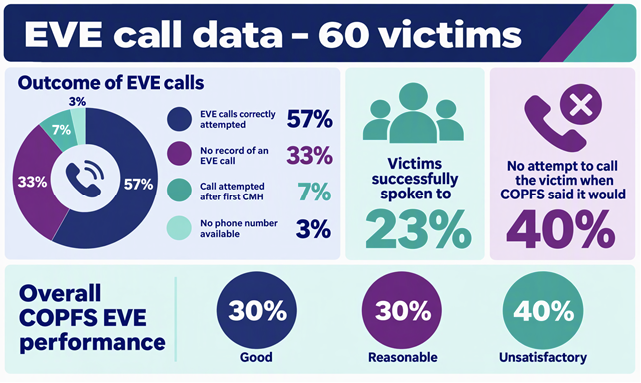
14. We assessed the performance of COPFS in the EVE call procedure for all 60 cases as follows:
Good 30%
Reasonable 30%
Unsatisfactory 40%
15. Where telephone conversations between prosecutors and victims took place, these were assessed overwhelmingly positively. The evidence available indicated that victims valued the EVE call process. We identified some examples of prosecutors successfully re-engaging victims who were at risk of disengagement. Prosecutors interviewed during the inspection were consistently positive about the benefits of EVE, particularly for victims of domestic abuse.
16. Where a prosecutor is unable to contact a victim because a telephone call is unanswered or no contact number is available, a letter should be issued to the victim advising that an attempt has been made and inviting them to contact COPFS by telephone. Our review found that such letters were rarely issued. We also observed uncertainty regarding responsibility for generating and issuing these letters, with differing views as to whether this falls to VIA staff, prosecutors or administrative staff.
17. Interviews with prosecutors indicated that the principal challenge in delivering EVE relates to resource constraints rather than a lack of commitment. While SCM has reduced the volume of cases proceeding to trial, it remains unclear whether this reduction has been enough to offset the additional demands placed on prosecutors by the SCM and EVE processes. Our findings suggest that resources are not always sufficient to support full implementation of the EVE model as originally envisaged.
Are EVE calls being made?
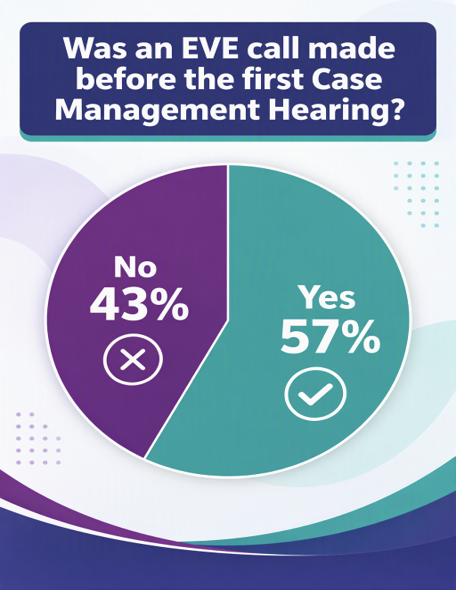
18. In 57% of cases there was evidence of a call being attempted correctly. In 43% of cases there was no evidence, or some other failure of process, namely:
33% of all cases in which there should have been an EVE call there was no record of any attempt at a call
7% of cases there was evidence of an attempted call after the relevant CMH
In 3% of cases there was no telephone number available
This means that the purpose of EVE calls is not always achieved and many victims are being left without prosecutor contact and important information about their case.
19. Trust is a fundamental principle of trauma-informed practice and is particularly important in supporting victims of domestic abuse throughout the prosecution process. Following the accused’s first court appearance, VIA write to victims advising that they will receive an EVE call from a prosecutor in advance of the CMH. Our review found that 40%[13] of domestic abuse victims did not receive the promised call. Failure to deliver this commitment risks undermining victims’ trust and is inconsistent with the trauma-informed approach envisaged by the Victims, Witnesses and Justice Reform (Scotland) Act 2025.
20. In 2025-26, 34,585 domestic abuse charges were reported to COPFS. Proceedings were instructed in 91% of cases, and 73% were prosecuted in sheriff summary courts. This highlights the significant volume of victim engagement required of prosecutors and VIA staff. While SCM has reduced the number of trials, the number of domestic abuse charges reported continues to rise.[14] Against this backdrop, the time spent by prosecutors conducting EVE calls is a key consideration in managing summary domestic abuse prosecutions.
21. A recurring theme across the four offices for both VIA staff and prosecutors alike in speaking to victims of domestic abuse was that it can be, understandably, difficult and often inappropriate to limit the length of the call.
Why calls are not being made
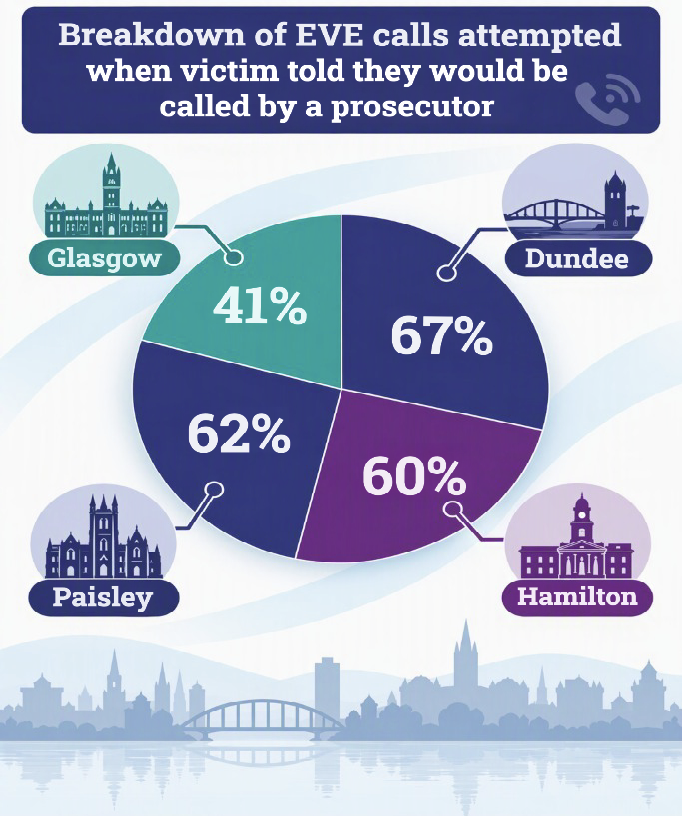
22. In Glasgow, domestic abuse cases prosecuted at summary level are managed by a specialist Domestic Abuse Team and prosecuted in dedicated domestic abuse courts, arrangements which pre-date both SCM and EVE. Consequently, almost all cases handled by specialist domestic abuse prosecutors in Glasgow require an EVE call. We found no evidence that additional resources had been allocated to reflect this increased demand. Prosecutors reported that they are frequently required to prioritise either preparing to address the court on the state of case preparation or undertaking EVE calls, limiting their ability to do both effectively. While prosecutors remained strongly committed to the principles of EVE, the current arrangements present significant operational challenges.
23. It is apparent that the well-intentioned specialist prosecution model at Glasgow was not adequately considered when SCM was adopted as a national model. Unless additional resources are made available to give prosecutors in Glasgow time to make EVE calls, or the specialist team model is reconsidered, the standard of service to domestic abuse victims in Scotland’s largest city may continue to be poorer than in the rest of the country. A further unintended consequence of SCM for Glasgow domestic abuse prosecutors and victims is that DASA meetings are not routinely being offered – this is discussed further below.
24. Dundee recorded the highest proportion of attempted EVE calls among the offices included in our case review. We noted that prosecutors in Dundee appeared to have more time allocated for case preparation and SCM-related court duties than their counterparts in the other offices examined.
25. COPFS internal guidance is clear that EVE should be facilitated if an accused is in custody. In eight of the 60 cases in our review the accused was remanded in custody following first appearance at court. In only one of the eight cases was there evidence of an EVE call being attempted by a prosecutor.
26. The implementation of SCM appears to have also had unintended consequences for domestic abuse custody cases across Scotland. While the relevant practice note states that SCM does not apply if an accused is remanded in custody[15] COPFS has instructed that EVE should still take place. The implementation of SCM on these cases does not appear to have been adequately considered, given that remand cases are subject to different timescales and procedural requirements from those that apply to CMHs.[16]
27. It is often the most dangerous offenders, with a history of domestic violence, who are remanded in custody at summary level. The unintended consequence is that the most vulnerable and at-risk victims are likely to receive the least support under SCM.
Value of recording EVE calls
28. In 87% of cases where we found evidence that an EVE call was attempted at any stage it was correctly recorded in the VIA minute sheet. The quality of records varied from brief notes to more detailed accounts that could be informative for VIA staff and prosecutors as the case progresses.
29. We were advised that the outcome of some EVE calls may not have been recorded or that technical issues may have prevented calls from being captured on the relevant systems. However, such explanations should be treated with caution given the consistently high levels of non-compliance with the EVE process identified in our case review data.
30. We understand that COPFS introduced a process to collate statistics on whether EVE calls were being made. This system is labour intensive, inconsistently applied and as a result COPFS does not currently know to what extent prosecutors across the organisation are making calls to victims or whether victims are answering calls. It is important for COPFS to remedy this and track this data, not least given the findings of our case review and to ensure that victims are receiving this contact.
31. We found numerous instances where information obtained during EVE calls – often a rich source of information – was not effectively utilised throughout the life of the case. This was particularly evident where victims had advised prosecutors of their preferred special measures for giving evidence, yet VIA subsequently issued standard correspondence seeking the same information or did not implement the victim’s wishes regarding special measures.
32. We observed repeated areas of inefficient overlap between the work of VIA and prosecutors conducting the EVE call.
Case study
A prosecutor took a detailed note of an EVE call and discussed the victim's wishes on a non-harassment order and how the victim would give evidence through a CCTV link. VIA staff did not see this record and applied for the victim to give evidence using a screen with the victim being in the same courtroom as the accused when giving evidence.
If a victim is asked a question and provides information, they should be able to trust that it will be recorded and considered. Failing to do so is not trauma-informed. It would be preferable for all concerned, particularly victims, if realistic responsibilities were clarified and adhered to.
Effectiveness of the EVE call process
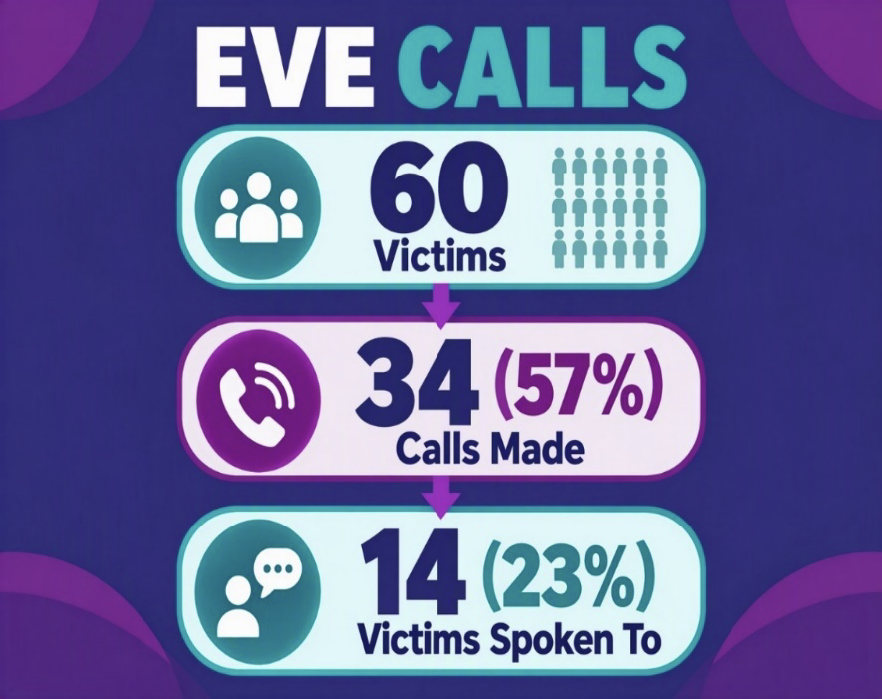
33. Of the 34 cases in our case review in which an EVE call was attempted correctly by a prosecutor, 20 calls were not answered. On one view COPFS should not be judged negatively if victims are not answering telephone calls however, the low rate of successful telephone contact with victims was specifically highlighted in our 2024 report.[17]
34. There was variation between offices in the timing of EVE call attempts. In some offices, calls were made around one week before the hearing, allowing time for further attempts or for victims to return the call. There was limited evidence that this approach improved contact rates. In other offices, calls were typically made one or two days before the hearing, leaving little opportunity for further engagement where initial contact was unsuccessful.
35. Prosecutors are instructed to make EVE calls from their COPFS laptop, which displays a 0300 number, or to withhold their number when using a mobile phone. However, victims not answering calls from unfamiliar numbers remains a persistent challenge and was a recurring issue identified in our 2024 review. COPFS should provide clearer information on how victims can expect to be contacted and use feedback from third sector organisations and victims to better understand and address unsuccessful telephone contact.
36. The effectiveness of EVE should be measured by the number of victims successfully engaged, rather than by the number of contact attempts made. We are aware that COPFS is considering changes to the summary VIA model, including greater use of telephone contact and fewer letters. While summary VIA staff now have mobile phones that can be used for calls and text messages, guidance on their use is still awaited. Given the low success rate of telephone contact with domestic abuse victims, with fewer than half of calls answered, we await the final proposals and evaluation of these changes with interest. In particular, we are keen to understand how COPFS intends to improve engagement and meet the communication needs of domestic abuse victims.
DASA meetings
37. DASA created an offence of engaging in a course of behaviour towards a partner or former partner that is likely to cause physical or psychological harm. Such cases frequently involve sustained patterns of coercive and controlling behaviour.
38. Since the offence was created the number of DASA charges reported has more than doubled from 1,022 prosecutions in 2019-20 to 2,616 in 2025-26. While there has been a significant increase in dealing with these charges at solemn level, the number of summary charges continues to grow. In the last year alone the number of summary DASA cases rose by 14% to 1,235 cases.[18]
39. In support of its strategic priority to tackle violence against women and girls, COPFS introduced DASA meetings in 2022. This allows victims to meet in person with the prosecutor who will conduct the trial in cases involving a charge under DASA and is intended to take place approximately two weeks before a trial. The increasing volume of DASA cases is a relevant consideration when assessing prosecutorial capacity to facilitate these meetings and is considered later in this report.
The purpose of a DASA meeting is to:
Allow the victim to meet the trial prosecutor before the day of the trial
Provide the opportunity for any remaining concerns the victim has to be addressed
Increase the confidence the victim has in the criminal justice process to handle their complaint competently, and with sensitivity
Overall DASA meeting assessment
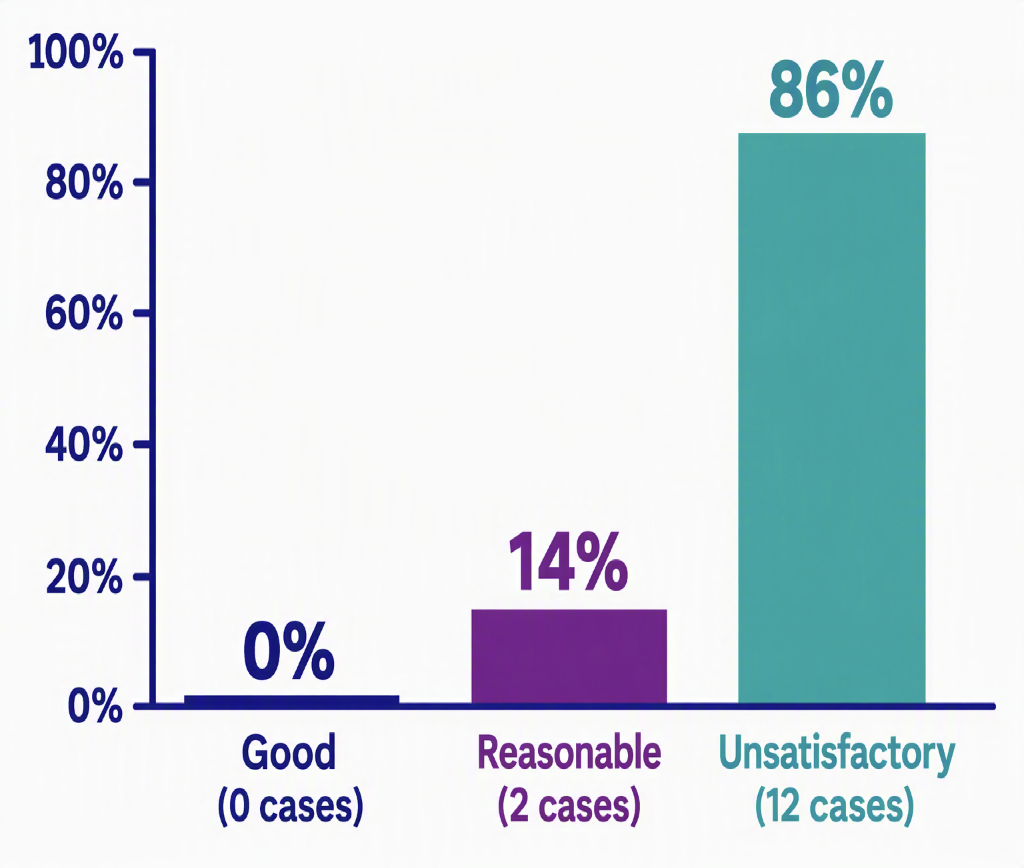
40. Our initial case review examined 60 cases. Sixteen involved a charge under DASA, of which 14 progressed to a stage where a DASA meeting should have been offered.
41. In one of the two cases assessed as reasonable, a DASA meeting was offered. However, it was conducted by telephone rather than in person and took place only three working days before the trial.
42. In the second case assessed as reasonable, and the only case in which an in person meeting took place, the meeting was held the day before trial and lasted approximately one hour. Inadequate records meant it was not possible to determine when the meeting was offered or who attended, other than the victim and prosecutor. Although the victim provided details of a new address during the meeting, this information was not shared with VIA or updated on COPFS systems. As a result, correspondence was subsequently sent to an address at which the victim no longer resided.
43. In 12 of the 14 DASA cases in our initial case review where the victim should have been offered a meeting, there was no evidence of one being offered or taking place.
Widening our sample
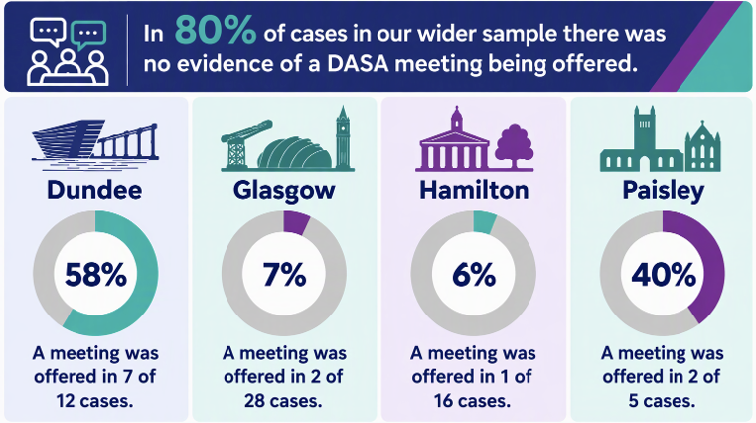
44. Given the very low number of DASA meetings that took place identified in our initial review of 60 cases, we considered that the sample might not be representative of wider COPFS practice. We therefore expanded the review to include all available cases involving a DASA charge reported in the four review offices between 11 July and 11 October 2025. This increased the sample to 98 cases, including 61 in which a DASA meeting should have been offered. Owing to resource constraints, our wider assessment was limited to whether a DASA meeting had been offered or had taken place.
45. There was no evidence that a DASA meeting had been offered or had taken place in 49 of the 61 relevant cases (80%). A meeting was therefore offered in only 12 cases (20%). Performance varied significantly between offices, with Dundee accounting for the majority of meetings offered. Excluding Dundee, a DASA meeting was offered in only 10% of eligible cases across the remaining three offices.
46. Of the 12 cases in which a DASA meeting was offered, the meeting took place with eight victims. This suggests that, when offered, victims are generally willing to engage with the process.
Reasons why DASA meetings were not offered
47. Interviews with prosecutors across all four offices demonstrated a clear understanding of the purpose and value of DASA meetings. Those with experience of conducting such meetings recognised their benefits. As with EVE calls, the low rate of DASA meetings does not appear to reflect a lack of commitment by individual prosecutors but rather constraints on capacity. These pressures are likely to be exacerbated by reductions in local court resources arising from the COPFS ‘national stabilisation’ programme. This has moved prosecutors and other staff from summary work to deal with solemn cases as a result of the Covid timebars coming to an end.
48. As noted previously, the Glasgow model does not adequately reflect the additional demands created by EVE. DASA meetings require significant preparation, time and sensitivity, particularly in cases involving prolonged domestic abuse. Our review of prosecutor court rotas in Glasgow indicated limited capacity to prepare for and conduct DASA meetings alongside other responsibilities. We understand that competing operational demands mean that such meetings are not routinely offered. Resource pressures across Local Court also affected the provision of DASA meetings in the other offices reviewed.
49. A further factor identified that prevented DASA meetings from being offered was the failure to allocate cases as Advance Notice or Advance Preparation trials. Practices varied between offices on this process, as did the time available for advance trial preparation, if any was given. In many instances, the process relied on prosecutors identifying DASA cases and alerting a legal manager following a not guilty plea. We identified cases where this did not occur, and others where cases were either not allocated or were allocated too close to trial to allow a meeting to be arranged. Unless these issues, which we previously highlighted,[19] are addressed, the DASA meeting process is unlikely to succeed.
50. Our consideration of court rotas across the four case review offices revealed a clearer emphasis on protected preparation time for CMHs in Dundee than in other offices. It is at this stage that DASA cases are identified for allocation. There was also a marked difference in Dundee with ‘trial preparation’ being an assigned rota duty – the level of protected time for prosecutors to prepare for trials in Dundee by comparison to other offices assessed was stark, as was the consequential increased level of standard of service.