
Related Downloads
Related Links
Additional
VIA Letters
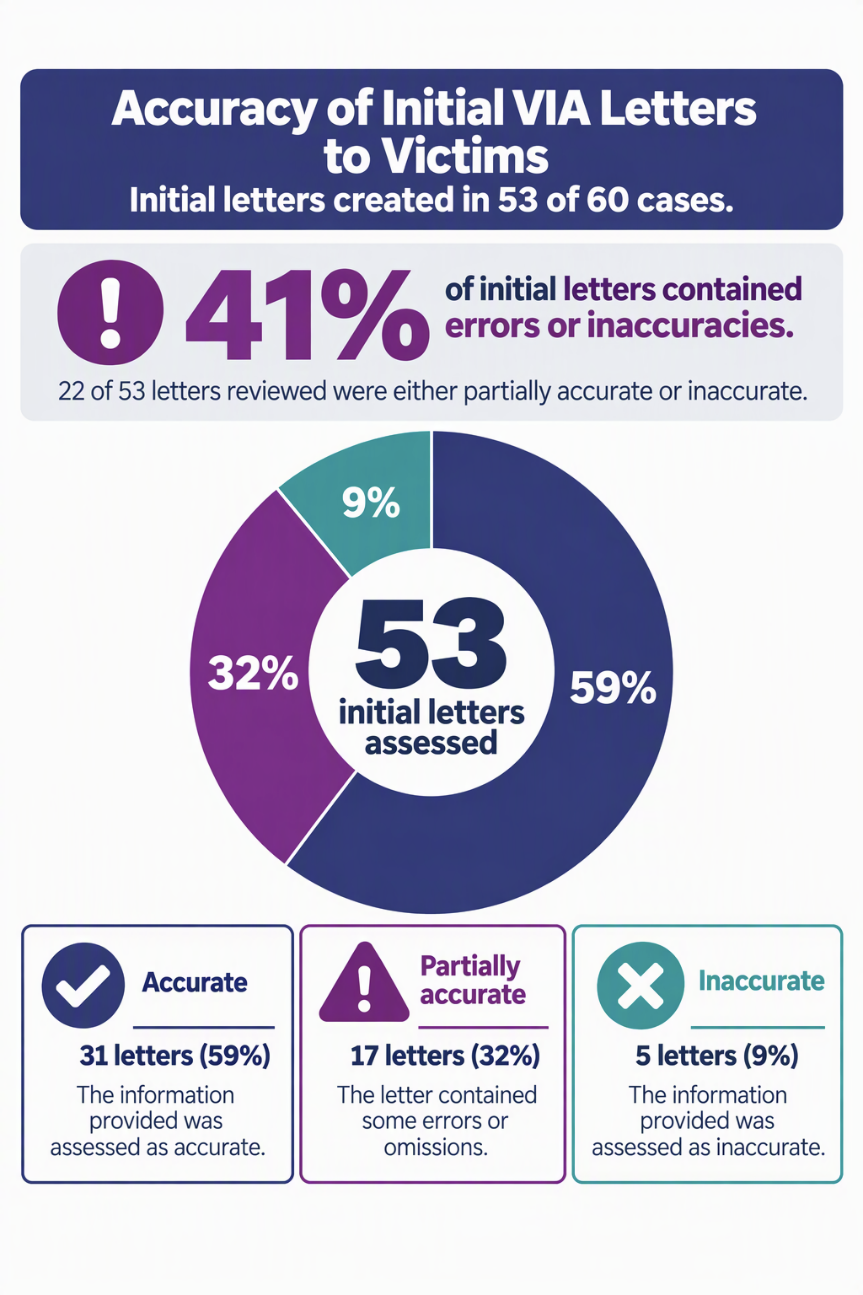
51. Currently, one of the main ways in which COPFS provides basic information to domestic abuse victims about their case is by letter. The VIA Modernisation Programme (VMP)[20] reviewed all VIA letter templates used by VIA officers to communicate with victims, witnesses and bereaved relatives at various stages of a case. This review was completed in July 2024.
52. The review was informed by contributions from VIA staff, COPFS personnel, third sector organisations, and a Victim Support Scotland reference group of victims, witnesses and bereaved relatives with lived experience. The Scottish Government's People at Heart style guide also informed the language and format of the letters.
53. The refinement of the letter templates remains an ongoing process. Further feedback from VIA staff and third sector organisations resulted in additional amendments being made to the templates in November 2025. We understand that further amendments were to be issued in October 2026.
54. Training and information on the revised letter templates were made available to VIA staff. This included a live webinar outlining the changes to the templates, which was recorded and made available for staff who were unable to attend to view at their convenience. Updates and briefings on the changes were also published on the COPFS intranet. Some of the VIA officers we interviewed had attended the training, while others were unaware that it had been available.
55. When the new letter templates were introduced in 2024, COPFS advised staff that they were:
Clearly designed and worded
Trauma-informed
Comprehensive
56. The aims of the project, the review methodology, and the collaborative work undertaken by COPFS and external organisations to improve communications with victims, witnesses and bereaved relatives are commendable.
57. We note that the revised letter templates are more personal and supportive in tone than the versions we examined in 2024. They provide victims with more information about court processes and outcomes and adopt a more trauma-informed approach. One example of this is the inclusion of a buffer page warning recipients that "the letter contains information about a criminal case which some people may find triggering".
58. The intention behind the revised templates is clear. VIA staff select the appropriate template for the relevant stage of the criminal case process and then choose from a range of pre-written paragraphs – essentially a ‘pick-and-mix’ approach to letter writing. Any sections that are not applicable can be removed, allowing staff to create a letter that ought to accurately reflect the progress of the case, explain the next stage of the process, and provide information on the support and services available to the victim.
59. Information such as the victim's name and address are automatically populated into the letter from the COPFS case management system. There is some information that VIA officers are required to enter manually, such as details of the date of the next court hearing, charges and any special bail conditions.
60. The intended outcome is a letter that is tailored to the specific circumstances of the victim's case which contains all required information in a nationally consistent format. However, our examination of VIA correspondence during the case review found that, in the vast majority of cases, this outcome had not been achieved. It is interesting to note that many of our findings mirrored those of our counterpart in England and Wales.[21]
61. In many cases, the letters issued to domestic abuse victims could only be described as ‘Frankenstein’ in style – a patchwork of mismatched paragraphs pieced together. The letters were often incoherent, included template headings that were irrelevant to the circumstances of the case or other errors. As a result, the correspondence was frequently confusing, nonsensical and inaccurate. In many instances, it fell well below the professional standard that victims are entitled to expect.
Template errors
62. We found that VIA staff often selected the wrong letter template for the relevant stage in the case. These templates have been specifically drafted to contain the information that a victim should receive after a particular calling of the case and are clearly identified by title on the case management system.
63. We could not fully understand why the wrong templates were selected by VIA officers. We could only conclude that this may have been due to a lack of understanding of the criminal court system, carelessness, or a preference for a particular letter style. In one office we noted that one experienced VIA officer often selected a case management style letter in place of an initial letter (letter to be sent to the victim after the first appearance in court by an accused).
64. Using the wrong template letter and/or poor tailoring resulted in:
important information being omitted
the same information repeated to victims
incorrect hearing types being referenced
irrelevant information being included
contradictory information
the victim becoming confused
victims being wrongly advised that they should have received a witness citation
This is contrary to trauma-informed principles.
Case study
VIA repeatedly used the wrong letter template when writing to a victim. In one letter the victim was told that a trial had been adjourned when no trial had taken place and, in another letter in the same case, the victim was advised that she need not attend the next calling of the case when it was in fact a trial.
Poor tailoring and inaccuracies
65. During the inspection, VIA staff interviewed expressed mixed views about the revised letter templates. Some considered them a significant improvement – more intuitive and easier to complete. The reduction in the number of templates was also welcomed by most interviewees. Others felt that the templates contained too much information for victims to properly absorb. Some VIA officers were concerned that the length and complexity of the templates increased both the time required to prepare letters and the risk of errors. The style template letters are substantial documents; the template for the initial letter is currently 18 pages of standard paragraphs and sections to be edited by VIA officers. Despite these concerns, the overwhelming majority of VIA staff interviewed reported that they were confident in producing letters using the revised templates.
66. COPFS seeks to reduce the risk of errors in drafted letters by including the following instruction in bold within each template:
“Keep relevant headings (those not underlined) and delete all headings and paragraphs that are not required. Information should not be duplicated, please proofread before sending.”
Despite this guidance, our case review identified numerous examples where these instructions had not been followed and too many examples of letters that had not been edited with sufficient care or attention. This not only rendered the letters inaccurate but, in some cases, made them difficult or impossible for victims to understand. VIA officers must be prepared to spend the time revising and refining the correspondence accordingly.
67. Further evidence of a lack of proofreading was heard during staff interviews, with one VIA officer stating that they simply did not have sufficient time to proofread the correspondence they prepared. In some cases, lack of care in preparing letters causes risk to the victim:
Case study
A victim was informed in a VIA letter that the accused had been remanded in custody when the accused had been granted bail and remained at liberty. This incorrect information was included in the letter despite the corresponding entry on the VIA minute sheet for the court hearing clearly stating, "bail continued".
68. VIA staff are required to provide victims with information about future court dates. While our case review identified a small number of factual inaccuracies on dates, we found that, overall, letters generally contained the correct dates for upcoming court hearings.
69. We also observed examples of good practice during our case review. Some VIA officers tailored their letters carefully to the circumstances of the victim and the case. In particular, the use of bold text to draw attention to key information was an effective means of improving the correspondence.
70. We found that in some cases, the same initial letter template was used throughout the lifetime of a case to provide updates, resulting in victims repeatedly receiving the same introductory information. In addition, victims were often sent the same two-page section explaining how to obtain a translated version of the letter, regardless of whether they had received this information previously. Not only does this highlight that COPFS is not tailoring their correspondence to individual victims as intended but it risks frustration and confusion for those who must repeatedly read, often lengthy, information which they have already received.
71. These issues with overuse of initial letters and poor tailoring were highlighted in feedback provided to COPFS by a victim, who commented:
“I have now received 3 letters from you, so the first 5 paras are unnecessary as are the 2 pages of other languages”
72. While it is important that victims receive all relevant information and support options, this has resulted in letters that are often excessively long. We found that key information a victim would be most interested in, such as the outcome of a court hearing or a significant case update, was frequently buried several pages into the correspondence. As a result, key messages were not immediately accessible, and victims were required to search through lengthy sections of text to locate them. This concern was also reflected in feedback provided by a victim to COPFS, who commented: “The case update info should be on page 1”.
What causes difficulties with template letters for VIA staff
73. One clear contributing factor is the general lack of effective quality assurance within VIA of the letters drafted. There should also be regular quality assurance by managers to ensure that appropriate standards are being maintained and to identify any training or performance issues within teams. During our interviews, we heard of positive practice in one office, where a manager undertakes periodic dip-sampling of correspondence produced by staff.
74. A downside of this ‘pick-and-mix’ approach to letter writing is that it removes the need for the drafter to think critically about the content of the letter. The process becomes robotic, diminishing the drafter's role in considering whether a particular paragraph is appropriate to the circumstances of an individual case or in tailoring the letter to meet the victim's specific needs and circumstances.
75. From some of the letters we examined during our case review, it is possible that certain errors arose because not all VIA officers had a full understanding of the criminal justice process. This lack of knowledge can result in paragraphs being combined in ways that are procedurally inaccurate, illogical, or potentially misleading.
76. As we identified in our 2024 report,[22] the absence of any clear governance structure for VIA within COPFS has resulted in inconsistencies in practice, together with a lack of national monitoring and oversight of the service provided by VIA. The impact of this can be seen in the quality of letters which are being issued to victims. Our recommendation remains relevant and outstanding.
77. A further factor contributing to issues with correspondence is insufficient staffing levels within VIA and the resulting backlog of work. During interviews, VIA staff consistently reported backlogs and delays in communicating court outcomes to victims. The pressure to reduce outstanding work and issue letters to victims as quickly as possible may increase the risk of errors, carelessness and lack of attention to detail in this important correspondence.
Raising expectation and false promises
78. COPFS has stated that it will make trauma-informed practice a core expectation.[23] There is now a legislative requirement to embed trauma-informed practice across the criminal justice system.[24] As previously mentioned, a key principle of trauma-informed practice is the development and maintenance of trust. It is therefore important that organisations and their staff do what they say they will and deliver on commitments made to victims.
79. At the time of our review, the standard initial letter sent by COPFS to victims in many cases advised that the case had been continued to a CMH and that VIA would contact the victim thereafter to provide an update on the outcome. However, too often we found that this commitment was not fulfilled, with no such update being provided.
80. Similarly, one of VIA's key roles is to keep victims informed of significant developments in a case, including the outcome of a trial and any sentence imposed. As discussed below, we found that these updates were too often not provided. In some cases, victims were never informed of either the final outcome of the case or the sentence imposed. Of the 60 cases reviewed, 39 required victims to be informed of the final sentencing decision. This occurred in only 22 cases.
81. While there is a commendable ambition that VIA should communicate in a tailored way that meets victims’ wishes or needs this is simply not happening. Initial letters to victims invite them to contact COPFS to let it know if they want to be updated after every hearing or to explain how they would prefer to be contacted, but our review showed very few victims do this. Worryingly we also found clear evidence that when victims in summary cases did provide their communication preferences, they were often ignored. Standardised letters were issued despite requests for email correspondence, and victims who had specifically requested updates after all court hearings frequently did not receive these.
82. For victims of domestic abuse, many of whom will already have experienced significant trauma, such unmet commitments can be re-traumatising and are likely to undermine their confidence in both COPFS and the wider criminal justice system.
Delay in letters being sent
83. At the time of our inspection, VIA staff generally operated a hybrid working pattern, spending part of the week in the office and part working from home. Most offices used a rota system to ensure that members of the VIA team were present in the office each day. As VIA officers frequently prepare correspondence while working from home, they are often unable to print and post letters directly to victims.
84. We found that a variety of processes were being used across VIA offices to manage correspondence, with limited consistency or formal oversight. In most cases, VIA staff working from home emailed the letters they had prepared to colleagues who were working in the office. These letters were then printed and posted either on the same day or the following day. In some offices, letters were sent directly to a colleague's email account, while in others they were saved to a shared folder for printing. This approach can result in staff working in the office spending a significant proportion of their time printing letters and preparing them for posting. We also found that some VIA officers adopted a different approach, retaining letters they had prepared while working from home and printing and posting them only when they next attended the office.
85. In some offices, we found home working contributed to delays in correspondence being issued to victims. When combined with the practice of sending all letters by second-class post and the limited service by Royal Mail,[25] victims may not receive correspondence until up to a week after it has been prepared. These delays, combined with backlogs, often result in victims receiving important information about their case some significant time after the relevant court hearing or the victim telephoning COPFS to find out the information themselves.
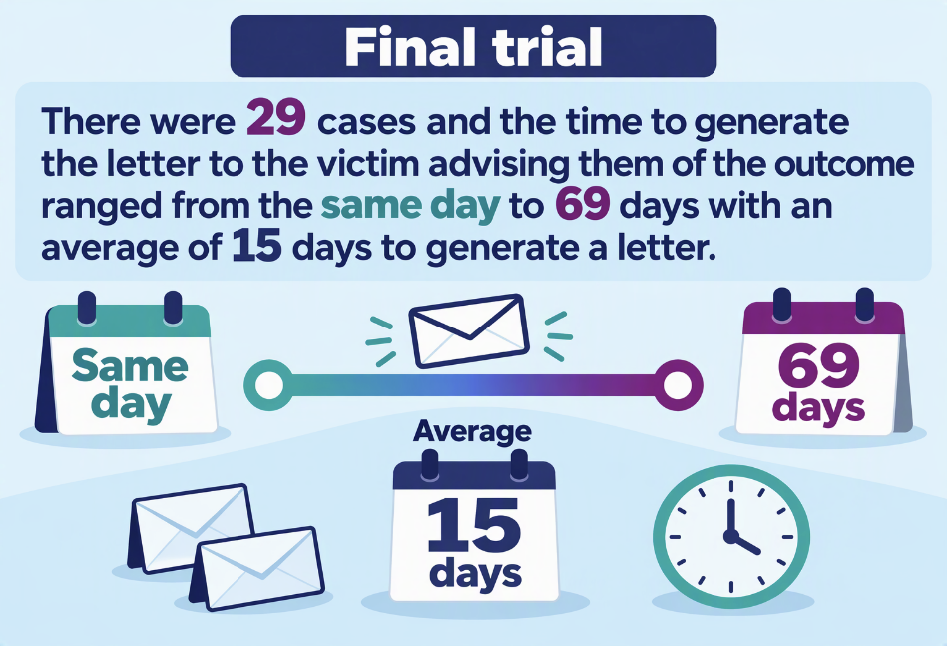
86. Another aspect of the delay in victims receiving letters was captured in our case review. The number of days from the case calling in court taken until a VIA officer generated these letters is shown below:
87. The limitations of COPFS case management systems, combined with the current processes adopted for printing correspondence, means there is no reliable audit trail to provide COPFS with assurance that a letter has actually been printed and posted to a victim. During our case review, we were able to verify that letters had been generated on the case management system; however, there was no visible record within the system, nor any user-generated note, confirming that the letter generated had subsequently been printed or posted.
Contact information
88. We noted that many letters sent to victims were either unsigned or only partially signed by the author. Practices varied between offices and among VIA officers within the same team. Some VIA officers included only their first name, others used their initials and surname, while some did not include any name at all. On occasion an illegible jpeg image of a signature was added.
89. We were told that some VIA officers do not put their names on letters because of safety concerns and the risk of being identified on social media. Others were concerned that including their name might give victims the impression that they have a designated officer whom they can contact directly to discuss their case.
90. As an organisation committed to improving communication with victims and witnesses, VIA correspondence should be appropriately signed, with at least an initial and surname. Alternatively, there should be a clear and consistent policy on the use of names in correspondence that all staff are required to follow. Considerable time has been invested in ensuring that the new letter templates are trauma-informed and personable. The letters are written in the first person and contain phrases such as, "Please let me know," "I am here to support you," and "You can also contact me for help". This style of communication is inconsistent with an unsigned, anonymous, and generic sign-off such as "Victim Information and Advice" which is unlikely to foster trust or encourage victims to contact COPFS.
91. We also noted a lack of consistency in the contact information provided to victims in VIA letters. Corporate guidance instructs staff that, while the letter templates contain the National Enquiry Point (Enquiry Point) telephone number as standard, VIA officers should also add their local team hunt group number. This enables service users, particularly victims, to contact the local team directly. However, we found that some officers and offices included only the Enquiry Point number in their letters. We were unable to establish whether this was a deliberate decision or the result of a lack of awareness of the corporate guidance. One VIA officer told us that they routinely add the VIA hunt group telephone number to letters and believed that, where staff include only the Enquiry Point number, this may be an attempt to reduce the number of telephone calls received by VIA teams. One office also appeared not to have a hunt group facility.
Bail
92. When an accused is granted bail by the court, VIA should advise the victim of the bail conditions in the initial letter issued following the accused's first appearance. In subsequent correspondence after further court hearings, VIA should inform the victim whether those bail conditions remain in place or have been amended by the court.
93. We found that VIA officers always included this information in their initial correspondence. Standard bail conditions are prescribed by legislation,[26] and the court may also impose further conditions[27] tailored to the circumstances of a particular case. These are commonly referred to as ‘special conditions’ of bail.
94. Overall, information relating to special conditions of bail was accurate in the letters reviewed. However, we identified occasional instances where a condition had been omitted or inadequately described.
Charges
95. VIA officers are required to advise victims of the charges faced by the accused and of any charges to which the accused has pled guilty or been found guilty. In our 2024 report, we recommended[28] that COPFS develop guidance for staff to ensure a consistent approach to the information provided to victims regarding charges and accepted pleas. We understand that this guidance remains under development.
96. Our case review found that the issues identified in 2024 persist. Practices vary both between offices and among individual VIA officers. In one office, interviews confirmed what we observed during the case review: victims were often not advised of the specific charge or plea outcome and were instead told only that the accused had been "charged with an offence" or had "pled guilty to an offence". In other offices, victims were provided with at least the name of the charge, for example threatening or abusive behaviour.
97. There was also considerable variation in how victims were informed about amended pleas accepted by prosecutors. Practice ranged from providing a full explanation of amendments to giving no information beyond stating that the accused had pled guilty. In some offices, victims were told the charge to which the accused had pled guilty but were not advised of any charges in respect of which a not guilty plea had been accepted. As we saw in our case review, this created a risk that victims would believe the accused had been convicted of more offences than was actually the case.
98. Concerningly, we were told that some officers would provide additional details about a plea if a victim telephoned the office to enquire but were reluctant to include the same information in written correspondence. We found no clear rationale for this distinction.
99. The absence of national guidance, clear instructions, and effective quality assurance has resulted in geographical inequality for victims in obtaining full and accurate information on charges, pleas and amended pleas. COPFS should ensure that any guidance developed to address our 2024 recommendation fully covers these issues.
Translation
100. Police officers should identify within the Standard Prosecution Report (SPR) any victim or witness for whom English is not their first language. COPFS has put in place a number of tools and services to assist staff in communicating effectively with these victims. These include:
an initial letter containing two pages of instructions in a range of languages, advising victims what action to take if they require the letter to be translated. This acts as a safeguard in cases where the police have not communicated the victim's language needs within the SPR
access to a telephone interpreting service that enables a professional interpreter to facilitate real-time communication between a COPFS staff member and a victim or witness
a facility to have correspondence translated into the required language before it is issued to a victim through a contracted translation service provider
the ability to arrange interpreters for victims and witnesses attending court hearings
101. During our case review, we observed that VIA officers were not always making effective use of these tools when communicating with victims whose first language is not English. This created a risk that important information was not being communicated in a manner the victim could understand. Two examples are set out below:
Case study
The SPR recorded that the victim required a Romanian interpreter. However, the VIA officer contacted the witness without arranging an interpreter and was surprised when the victim indicated that they could not understand the conversation. Rather than using the telephone interpreter service to facilitate communication, the VIA officer sent the witness a text message in English and did not update the VIA minute sheet to record the language barrier or the action taken. No initial letter was subsequently issued in any language. Throughout the case, VIA did not arrange for correspondence to be translated or use the telephone interpreter services. Communication continued on the assumption that the witness was able to understand English.
Case study
The SPR recorded that the victim did not speak English and required the assistance of an Arabic interpreter. This information was noted on the VIA minute sheet and highlighted for attention. Despite this, there was no evidence that VIA officers took any steps to have correspondence translated or to communicate with the victim through the telephone interpreter services. There was an avoidance of telephone contact with the victim throughout the case. The only translated correspondence identified was issued following a prosecutor’s instruction to seek the victim's views regarding a non-harassment order. This was noted on the VIA minute sheet but there is no copy of the letter on the case management system. No other translated letters were sent, and interpreter services were not used. No correspondence was issued to inform the victim of the sentencing outcome.
102. In both cases we were unable to determine from the case records whether these failures resulted from conscious decision-making, a lack of training or awareness, workload pressures, or a combination of these factors. However, the victims’ identified language needs were not met in either case.
103. In accordance with section 2 of the Victims and Witnesses (Scotland) Act 2014 (the 2014 Act), Standards of Service for Victims and Witnesses (the standards) have been published by COPFS in partnership with other justice agencies.[29] The standards state not only that a victim or witness should be able to obtain information in relation to their case but should also:
“be able to understand the information you get – so the language should be easy to understand, and the information should be available in alternative languages or formats if you need them.”
This reflects a fundamental principle of the 2014 Act: the victims’ right to understand and be understood.[30]
104. From the evidence in our case review, victims’ identified language needs are not being appropriately addressed. COPFS should consider this issue as a matter of urgency.
Feedback
105. We were pleased to note that COPFS now seeks feedback from victims about the letters they receive. Feedback can be provided either by completing a form on the COPFS website or by scanning a QR code included in the correspondence. However, we found that scanning the QR code does not take users directly to the feedback form; instead, it directs them to the COPFS homepage. From there, the feedback form is difficult to locate. We were unable to understand why the QR code does not provide a direct link to the relevant form, as is common practice in many other organisations. Victims who are willing to provide feedback may become discouraged by the challenging steps required and may ultimately abandon the process.
106. Since the introduction of the feedback process, COPFS has received four responses, although two of these were submitted by the same victim. The low level of engagement may, in part, be attributable to the difficulties users encounter when attempting to locate the feedback form. The feedback received indicated victims value the information provided and found the tone of the communication from COPFS appropriate. A recurring theme was that the letters are overly long, repetitive and do not sufficiently prioritise key case updates. This reflects many of our own findings during our inspection.
107. A further source of feedback for an organisation is from complaints received from service users. Between 1 January 2025 and 14 October 2026, COPFS received 31 complaints regarding lack of communication in VIA summary cases and 11 of these related to domestic abuse cases.[31] The most common themes identified from these complaints reflected what we found in our own review, namely failure to provide court updates, delays or failures in responding to victim enquiries, and failures to keep victims informed about important developments in their cases.